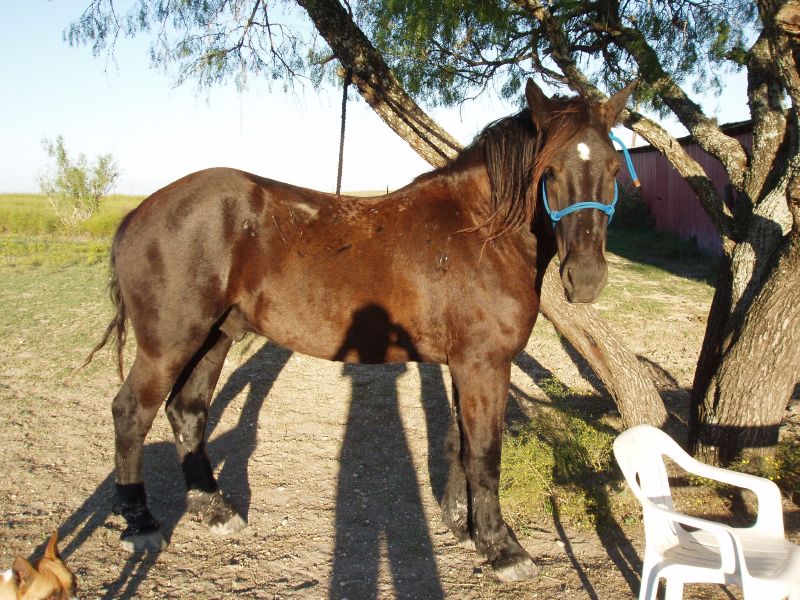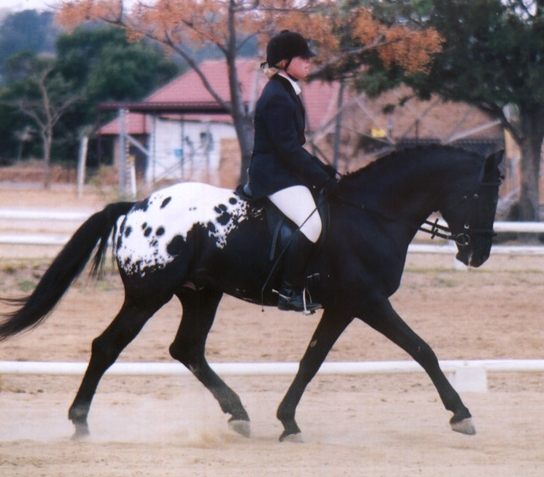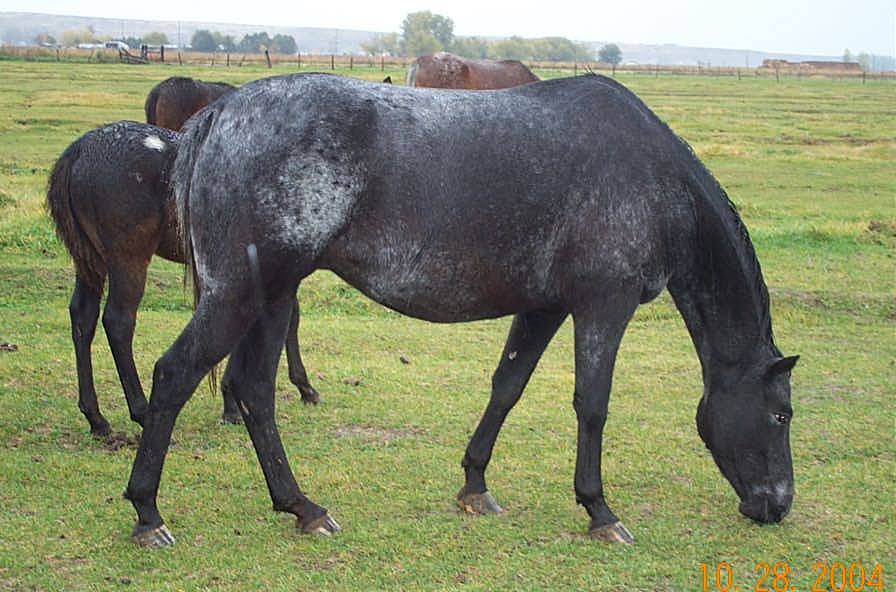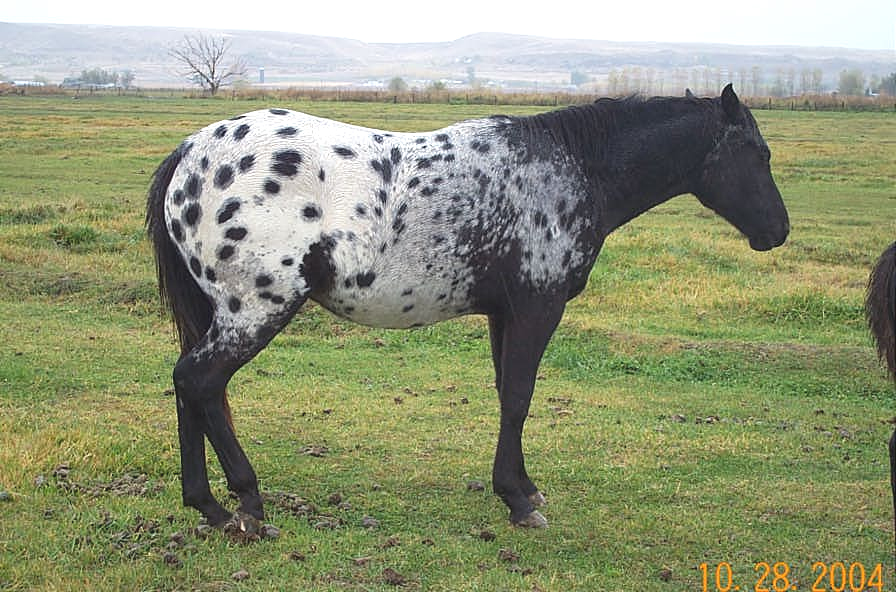
Someone was kind enough to send me the link to the site for the extremely diluted grulla appaloosa mare in a previous post. There are many more (high quality!) pictures of the mare there.
And now back to work! I have been mired in the got-to-make-publication deadlines, but I will return to studio things soon. (Someday I will write for a magazine and not be the editor's "problem child"... really, I will!)
Thursday, August 28, 2008

Friday, August 22, 2008
Why we do what we do

I think for most artists who focus on them, there is just something about the spirit of the horse and their bond with mankind. It draws us to them again and again. I thought this picture of my youngest son, Matthew, and his best buddy, Rose, captured a bit of that.
Black it is!
In a post last week, I mentioned that I was sending a hair sample from my appaloosa mare to UC Davis, in order to find out what color she truly was. Underneath her white pattern, the base color was an odd brown shade. I found over time that most horse people were inclined to call her black, but her lower legs were tan. Typically when black horses fade in the sun, their lower legs retain color in the same area that is black on a bay horse. This Percheron is a good example. He looks bay, but genetic tests show him to be black. That is why the hair above the hoof is often a good indicator for determining if the horse is faded black or a liver chestnut.
The hair on my horse's lower legs was most definitely not black. If anything, it has always been the palest area of color on her, as this winter picture of the back of her leg shows.

So it would be reasonable to believe she was chestnut. Still, to someone who looks at color a lot, there was something "off" in the tone for her to be chestnut. Certainly some chestnuts are a rather dull color, but the tone was enough for me to suspect she was some kind of dilute. Recent studies on the appaloosa patterns had shown that many black appaloosas had their color altered, and I had long noted that many appaloosas had base colors that were just hard to pin down as any specific thing. I suspected that this was what was going on with Sprinkles, but without a test I couldn't really be sure.

Yesterday I received her test results, and my guess was right. She is "aa" - genetically black. She carries the chestnut gene (e) but is not herself chestnut.
With that in mind, I thought it might be fun to post a group of photos showing some lower legs and the difference in tone between some of the colors. This is the kind of thing that artists need to keep in mind when painting different colors, because getting the tone right makes all the difference in portraying a given color.
One caveat though. Photographs are not the best way to really see these differences. All the ways we record and transmit images (film, printing, monitors) can distort color, and with something like this what we are dealing with are very subtle differences in tone. These are my own images, taken with the same equipment in close proximity to one another, but still viewing these colors in real life (preferrably side-by-side) is the best way to see. Indeed, the tone in color is really best studied from life because the camera rarely captures what is so obvious in person. But we will do the best we can with what is possible over the internet!

These are the legs of a sooty palomino pony. Notice how yellow in tone the lightest areas are. "Yellowness" is one of the best indicators for the presence of the cream gene. (For those that downloaded the new color charts, these legs go with the palomino pony pictured on the second page.)

These are the legs of a red silver pony. This horse is genetically bay, and you can see the unaltered red hairs on the upper leg. His black lower leg has been diluted by the silver gene, turning it a bluish chocolate. The overall tone on the lower legs is very cool, especially compared to the yellow of the palomino above.

And these are Sprinkle's legs. Again, she's genetically black so like the silver legs above, this is a diluted form of black. The color isn't cool, however. It isn't yellow, but it's not really red either. If I had to call it something, I would say it is a bronze tone. I would also add that she does not really fade to this color; it's pretty constant through the seasons.

Here is a side-by-side comparison of the leg color, with an addition of a sooty chestnut to compare against a truly red leg. (With all these images, you can click to get a larger version.)

And finally here is Sprinkles' legs beside a flaxen chestnut leg and a truly black leg, showing the contrasting tones.
No one really knows at this point why the pattern dilutes the black on some appaloosas, and of course some aren't diluted at all. But it does happen with some frequency, and it offers a neat variation for artists painting appaloosas.
Wednesday, August 20, 2008
In Memory
Scott Alan Jeffreys
December 24, 1966 - August 20, 2002
 My brief moment, sometime around age seven, of being taller than my twin. (He would end up almost eight inches taller than me.)

When people talked about children with Christmas birthdays getting 'cheated' on presents, I used to tell them they should try that birthday as a twin. Four gifts in one! But what do you get a boy and a girl together? Board games. Oh my, did we get board games!

As much as I always loved horses, Scott loved cars. He eventually traded model cars for real ones, but somehow I stuck with both real and model horses.
My mother shared these pictures with me while visiting recently. She had found them going through some old boxes. But my favorite was an old Christmas letter from my grandparents, dated around the same time as these photos. My grandmother writes of us: "Both kids are doing well in school. Scott is meticulous and has lovely handwriting. Lesli is not so neat, and her teacher says she talks too much." I thought those of you who know me well would find that particularly amusing. (My family here - the ones that live with my disorganized, talkative self - sure did!)
And to my Jeffreys and Harbin family members, I am thinking of you all on this day and hoping you find comfort in the many good memories Scott left behind. I love you all - and him - always.
December 24, 1966 - August 20, 2002


When people talked about children with Christmas birthdays getting 'cheated' on presents, I used to tell them they should try that birthday as a twin. Four gifts in one! But what do you get a boy and a girl together? Board games. Oh my, did we get board games!

As much as I always loved horses, Scott loved cars. He eventually traded model cars for real ones, but somehow I stuck with both real and model horses.
My mother shared these pictures with me while visiting recently. She had found them going through some old boxes. But my favorite was an old Christmas letter from my grandparents, dated around the same time as these photos. My grandmother writes of us: "Both kids are doing well in school. Scott is meticulous and has lovely handwriting. Lesli is not so neat, and her teacher says she talks too much." I thought those of you who know me well would find that particularly amusing. (My family here - the ones that live with my disorganized, talkative self - sure did!)
And to my Jeffreys and Harbin family members, I am thinking of you all on this day and hoping you find comfort in the many good memories Scott left behind. I love you all - and him - always.
Monday, August 18, 2008
Updated Color Guide

Cerbero, brown tobiano Neopolitan owned by Emperor Charles VI, painted by Johann Georg von Hamilton in 1725. (Lipizzaner Museum, Vienna, Austria.)

Pluto-Lina, also called Bajazzo, a Lipizzaner stallion born in 1913. This photo is from book Pferde aus Licht und Schatten. (A wonderful book, by the way, even if you cannot read German.)
For years I have published an article, "What's Possible", that outlines the colors and patterns found in some of the more popular breeds. The idea was to give model horse show entrants and judges a better idea of what was accurate (and acceptable) for the breeds they were most likely to see in the show ring. At the end of the year I would update the charts in the article to reflect any new discoveries or changes in registry rules.
This past year, I realized that the charts had reached the point that merely updating them was not enough. They needed an overhaul. Appaloosa patterns are more complex than the current chart reflects. New colors like pearl and Dominant White need to be added, and something needs to be said about mushroom and "light" (or dilute) blacks. There was also a companion article entitled "More Possibilities" that was never published. It had the same kind of information on some of the less common breeds. The more I looked at both articles, the more convinced I became that I just need to get back to work on the book those charts were supposed to summarize!
I'm still working on that, but since I am still a long way from finished it seemed a good idea to at least correct the article and republish it. I know many showers and judges still refer to the charts, so accurate but incomplete information is better than inaccurate information! Newly updated charts (in PDF form) can be found here.
There are a lot of changes, in part because it has been so long since they were last updated, but also because I've made an effort to be a bit more thorough in noting historical ("extinct") colors. (Like the Lipizzaners in the pictures at the top of this post.) The rise in registries with online databases has also allowed me to pin down some of the genes that were previously listed as "unknown".
And finally I should note one entry that is sure to be controversial. Yes, there are questionable circumstances surrounding that horse's papers, and yes, I know the registry has been informed. I had actually delayed uploading these charts, hoping that the issue would be resolved. As of this morning, this horse is still listed on DataSource as a registered purebred. Legitimate or not, unless and until those papers are revoked that color is in the breed.
Wednesday, August 13, 2008
A confession

This is the sign that should have hung on my studio door this summer - Gone Fishing!
I like plans. I dislike the unexpected and I am happiest when there is a clear plan. So Alan and I started our marriage with a plan. I would quit my day job so I could devote myself more fully to my artwork. I would continue to freelance as a technical illustrator while I built up my equine art business. The business would be well-established when we had children, and I could stay at home with them and still work.
When we found out we were expecting our first son, I promptly went out and found a book on raising children while running a home-based business. I had no idea what having a baby in the house might mean to my established work routine, so it seemed sensible to get more information. (My husband finds much amusement in my firm belief that no matter what new thing I must do, someone somewhere must have written a book telling me what to expect.) I still remember following along in the book, thinking the author was making sense until I got to one of the charts. It listed the age of the child in one column, and the number of hours one might reasonably expect to work while at home with the child. And there in the first row, marked 0-6 months, was the number zero. Zero hours – a week. It didn’t get much better, either. If I remember correctly, by age two you were up to five hours a week. I never read the rest of the book, convinced that I didn’t need advice from one of the few people who appeared to be worse at time management than me.
It was the first lesson in what I’ve come to think of as a (now) twelve-year course in humility. I’m still wondering how she managed those five hours at age two.
I spent a lot of time when my children were young wishing for enough personal space to create some artwork. (Or maybe just sleep.) I dreamed of the day that they would head off to school so I could reclaim my career, or at least some small part of it. I told myself that one day, my children would not need me quite so much, and that it would be easier to get work done. And over time that has happened.
That was why when I planned my summer, I assumed that I would be working. The boys did not need my constant supervision. No one would mind, or perhaps even notice, if I was holed up in my studio working. Why, I could finally hold the first-time winner’s lottery I had long wanted to have!
But then something happened. (Parenting Rule #1: Something always happens.) My older son finished fifth grade this year, and he was asked to give the student speech at the graduation. I have always found it odd that my quiet, introverted child enjoys public speaking. He’s also a very respectful child, so I was even more surprised to find him balking at requested edits. Both his teacher and his father tried to no avail. Then the day before the ceremony, I discovered why while volunteering in his class. His classmates were celebrating the lack of homework when I reminded my son that he would spend the evening working on the edits to his speech. Suddenly there were ten boys all shouting that it was perfect – absolutely perfect! – and that he need not change a word. The next day he gave his unchanged speech, full of confidence and own dry humor, to crowd of kids and parents. And it was perfect just as he wrote it. But even more important, I caught a glimpse of my son as his friends saw him and how important this would be to him in the future.
He’s still very much a kid, but it did bring home to me how little time we parents remain central to our children’s lives. For all that the days seemed so (unbearably!) endless when they were really small, time seems to me rather short now. All too soon, my sons will be fully their own people.
So this summer, I have lingered a bit in what remains of my kids' childhood. I’ve wiled away my summer days in their company. Yes, I’ve done some work in the studio, but mostly I’ve spent time with them at the pool and the barn. I've done a little house painting (an activity done with children only if you are brave and don't mind bright colors). I’ve played way too much Monopoly and Uno. I’ve been thoroughly schooled in ancient history (Brandon’s abiding passion) and been routinely beaten at Wii Tennis. In a few weeks, I’ll be back to work and I’ll have to figure out what to do with all the horses I haven’t finished over the summer. But I can’t say that I have any real regrets.
Tuesday, August 12, 2008
More thoughts on striped hooves
In the comments section of the last post, Melissa Gaulding made this observation:

This got me to thinking about the variation in tone on Sprinkle's hoof, and how different they are from Freckles, another appaloosa that shares a pasture with her (above). While the two horses were standing together, what struck me was how opaque Sprinkles feet were compared to Freckles. Shell hooves have always seemed to me to have a slightly translucent quality, and the other mare's feet retained a bit of that.
I wonder if this is just individual variation, or if base color might have something to do with it. Looking at the picture above, Sprinkles and Freckles might both appear to be chestnuts - one a darker liver and the other a true red chestnut. The truth is I am not sure if Sprinkles is genetically chestnut or black. The general rule of thumb is that faded black horses retain their black lower legs, so if the lower leg is faded the horse is most likely dark chestnut.

Sprinkles lower legs are faded, which should mean that she isn't black. But the leopard complex gene will often change black base colors to an odd bronze shade that most horsemen find hard to categorize. People around Sprinkles have that problem, not knowing whether to call her black, or chocolate, or grulla. (Grulla seems to be a used as a catch-all phrase by many horsemen, meaning "dark, dull color I cannot identify".) To give an idea of just how dramatically the appaloosa gene can distort the color of a black horse, I'll share a picture of another appaloosa that tested as genetically black.

(I apologize that this is not my photo, nor do I know its source. If it is yours and you would like it removed, please let me know and I will do so.)
All this gave me the final push to have UC Davis test Sprinkles. I have meant to do this for some time now, but at last I have sent the form with her hairs. I still don't know, as Mel mentioned, if there is any true black in nature, but at least I will soon know if I own a truly black horse! And in the meantime, I hope to collect more pictures of appaloosa hooves and see if the striping differs according to base colors.
So Sprinkles' grays in her hoof are going to more green or pink or blue, because the dark coloring isn't "true" black...

This got me to thinking about the variation in tone on Sprinkle's hoof, and how different they are from Freckles, another appaloosa that shares a pasture with her (above). While the two horses were standing together, what struck me was how opaque Sprinkles feet were compared to Freckles. Shell hooves have always seemed to me to have a slightly translucent quality, and the other mare's feet retained a bit of that.
I wonder if this is just individual variation, or if base color might have something to do with it. Looking at the picture above, Sprinkles and Freckles might both appear to be chestnuts - one a darker liver and the other a true red chestnut. The truth is I am not sure if Sprinkles is genetically chestnut or black. The general rule of thumb is that faded black horses retain their black lower legs, so if the lower leg is faded the horse is most likely dark chestnut.

Sprinkles lower legs are faded, which should mean that she isn't black. But the leopard complex gene will often change black base colors to an odd bronze shade that most horsemen find hard to categorize. People around Sprinkles have that problem, not knowing whether to call her black, or chocolate, or grulla. (Grulla seems to be a used as a catch-all phrase by many horsemen, meaning "dark, dull color I cannot identify".) To give an idea of just how dramatically the appaloosa gene can distort the color of a black horse, I'll share a picture of another appaloosa that tested as genetically black.

(I apologize that this is not my photo, nor do I know its source. If it is yours and you would like it removed, please let me know and I will do so.)
All this gave me the final push to have UC Davis test Sprinkles. I have meant to do this for some time now, but at last I have sent the form with her hairs. I still don't know, as Mel mentioned, if there is any true black in nature, but at least I will soon know if I own a truly black horse! And in the meantime, I hope to collect more pictures of appaloosa hooves and see if the striping differs according to base colors.
Subscribe to:
Posts (Atom)